

I’ve lost count of how many times I’ve watched someone relax when they see the number.
They’re usually somewhere around 62. They’ve saved for thirty or forty years, and they come in wanting one answer: can I stop working? We put everything in. The portfolio, what they expect to spend, Social Security, inflation, a guess at how long they’ll live. And the software says yes. The money should last.
You can see their shoulders come down. I understand that, and I’m glad for them.
But I’ve been doing this long enough to know that the moment of relief is also when I most want to slow down. That projection rests on a handful of guesses, and some of them will turn out wrong. Not because anyone was careless. Because nobody knows what the next thirty years will bring.
The market may drop the year after you retire. Inflation may hang around longer than it should. You may live to 97 instead of 87, which I hope you do. Taxes change. Health care gets more expensive. And almost nobody spends in retirement exactly the way they thought they would.
A projection tells you what happens if things go roughly as assumed. A plan helps you decide what to do when they don’t. Over the years I’ve come to think that difference is most of the job.
As a matter of fact, if you’ve used more than one financial advisor in the past you’ve probably gotten more than one projection. And that’s considering that all advisors use the same concepts and math, and you gave them all the same information.
What the numbers can and can’t do
I use planning software every day, and I’d be lost without it. But it can only work with what we feed it. If we assume 6% returns, 3% inflation and a thirty-year retirement, it will faithfully show us what that world looks like. It has no way of knowing whether that world shows up.
Returns don’t arrive in an orderly line. Inflation doesn’t hold still. Neither, frankly, do you.
We have to use assumptions; there’s nothing else to plan with. The trouble starts when a reassuring chart quietly becomes a promise in our minds. To paraphrase a legal disclosure: “Past results are no guarantee of future returns, but they’re all we have to go on.”
I think of two clients, really a composite of many I’ve known. Each had about $1.5 million and planned to spend around $90,000 a year, Social Security included. Their projections looked nearly identical.
The first treated the result as a finish line. The plan said it worked, so why keep poking at it?
The second wanted to know what would happen if it didn’t. What if the market fell early? What if prices kept climbing? What if the first few years cost more than expected, as they so often do? We worked out ahead of time what they would change, and when.
Same money, same software. One had a forecast. The other had a way to make decisions when the forecast missed.
When the market falls early
A bad market never feels good. But one that arrives in the first few years of retirement does more damage than the same drop later on.
While you’re working, a downturn is almost a gift. You’re still adding money, buying at lower prices, and you aren’t living off the account. Retirement flips that. Now you’re pulling money out to pay the bills, and if prices are down you’re selling at the worst possible time. Those shares are gone. They won’t be there for the recovery.
The industry calls this sequence-of-returns risk. Put simply, two people can earn the same average return over twenty years, and the one who takes the losses early can end up meaningfully worse off, purely because of the order.
That isn’t an argument for running from stocks. It’s an argument for knowing in advance how you’ll pay for life during a long slump. Is there cash set aside? Other income you can lean on? Room to trim spending for a while, and do you know at what point you’d actually do it?
I don’t spend much time asking whether the market will fall. It will. I’d rather we already know what we’ll do when it does.
When inflation won’t settle down
Inflation is a slower problem, which is part of why people underrate it.
Say a couple spends $80,000 a year. If prices rise 3% annually, in ten years that becomes roughly $108,000. At 5%, it’s closer to $130,000. That gap, more than $20,000 a year, has to come from somewhere, and usually it comes from bigger withdrawals. Bigger withdrawals leave the portfolio with less room to grow and less cushion for the next bad year.
It’s rarely even, either. In my experience retirees feel inflation most in the things they can’t easily cut: health insurance, property taxes, home repairs, and eventually help around the house. The headline number can look tame while your own bills tell a different story.
So rather than pick one inflation rate and hope, I like to look at a few. Then we talk about what can bend. Travel can shrink in a hard year. Some Social Security choices protect you better than others against rising prices. Part of the portfolio may need to be set up specifically to keep pace.
Just remember, other than 2021-2023 we’ve enjoyed very mild inflation for the last 35 years. However, looking back further than that it is obvious that steady inflation hovering around 2.5% is not what we’ve always had. So, don’t be afraid to use a higher rate of inflation in your projections to stress test them.

When you outlive the plan
Most plans pick an age and stop. Very few people question that number. But for a healthy couple in their early sixties, there’s a real chance at least one of them reaches their mid-nineties.
Running short of money at 91 is a far harder problem than leaving some behind at 85. So I usually prefer to plan a little longer. That might mean waiting on Social Security so the larger check lasts for life or setting aside part of the portfolio for the far end of retirement.
Why this is such an important theme for me: My mother just turned 93 last week. The average life expectancy for a female born in the U.S. in 1933 was 68 years. Both of her parents lived to be 94. The average life expectancy for someone born in the U.S. (both male and female) in 1901 was 49 years.
Living years, or decades, longer than you expect is already common place, and will become more so as Boomers and Gen Xers reach their 70’s, 80’s, and beyond. Unless you have a specific reason not to, PLEASE base your plan on living to at least 100.
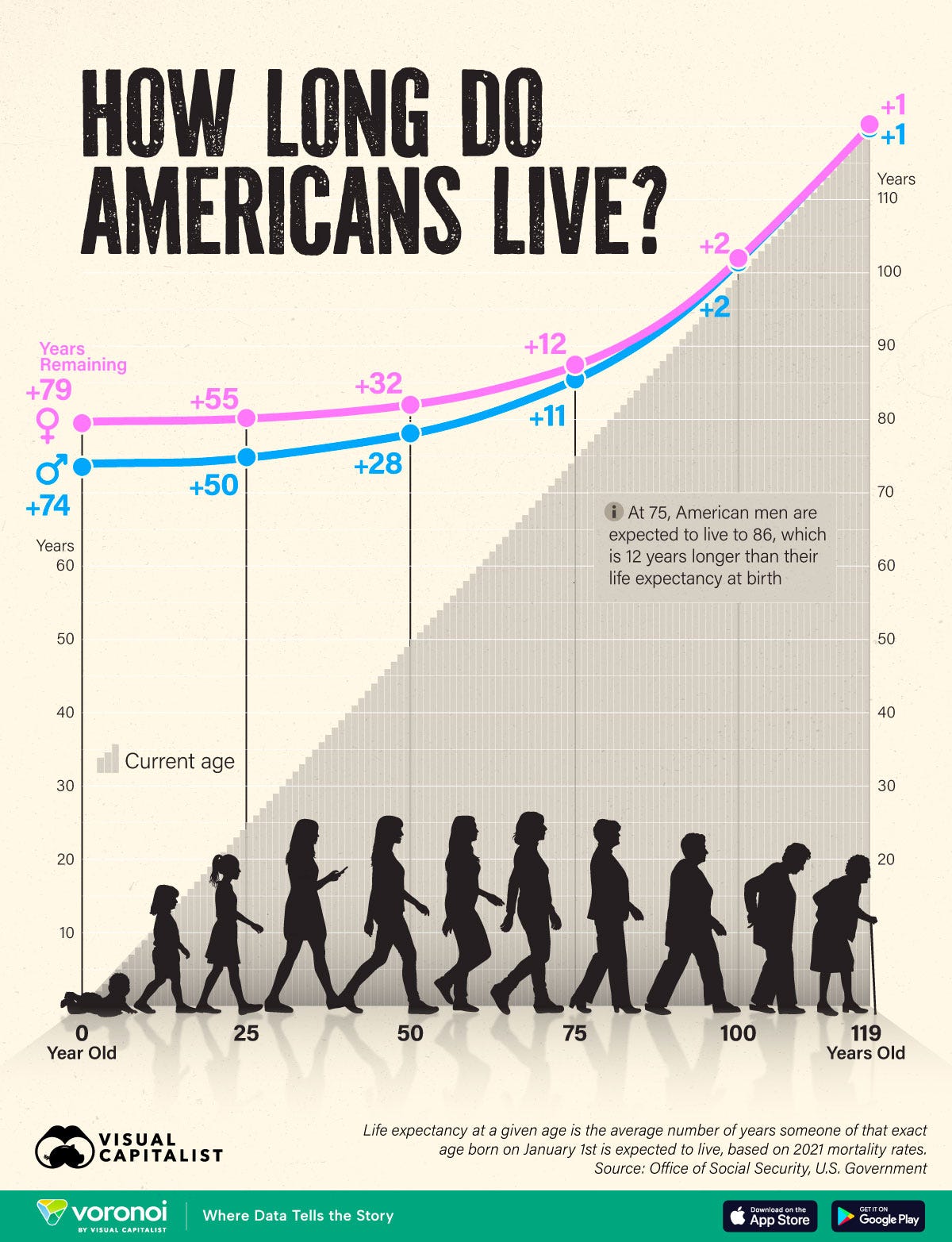
If you’re a 65 year old woman today, the Social Security Administration projects that you’ll live to be 86.
Today’s Age - SSA life expectancy
70 87
80 90
90 95
100 102
Add in advancements in longevity due to Boomers and later being more health conscious, better healthcare, and possibly more effective medications because of AI, and you’ll want to over estimate your life expectancy.
Taxes, health care, and the things nobody plans for
A few other assumptions tend to drift.
Tax rules change, sometimes a great deal. Health care can surprise even careful people, especially in the years before Medicare begins at 65, and again if long-term care enters the picture. And then there’s spending itself. Some retirees spend more than they expected early on, on travel, grandchildren, the kitchen they finally redo. Others need far less. Plenty run into something no one saw coming: a grown child who needs help, a parent who needs care, a roof that picks its moment.
Remember when you could deduct all of you interest expenses (credit cards, car loans, etc.) from your income? Good luck if you can still deduct your mortgage interest expense and/or the state and local taxes you’ve already paid. Get the idea?
None of this is cause for alarm. It’s simply life. But each of these can be thought through ahead of time, instead of for the first time in the middle of it.
INCOME CONSIDERATION
I know that many of you have planned your lifetime income to the nth degree for the next 30 years. However, in addition to taxes, healthcare, inflation, and other expenses how can your income be affected?
Tax rates, Social Security distributions and Cost Of Living Adjustments, and Roth status are current law, but are not carved in stone. Obviously, tax rates and COLAs change almost every year, but what about Roth taxation?
If in the future, Congress decides to reduce the deficit, or even pay down some of the trillions of dollars of national debt, they have two levers: Spend Less (don’t laugh, it is mathematically possible) or Charge More. The most common way to raise revenue is to raise rates, but what about reducing what is considered tax deductible or tax-exempt income?
Some of you probably fall under the Alternative Minimum Tax (AMT) because you planned, saved, and invested too well. Some of you are running your projections with taxable and tax-exempt income, but what if those classifications change?
Consider:
Key Historical Milestones For Roth IRAs and 401(k)s:
1989 (The “IRA Plus” Proposal): Senators Bob Packwood and William V. Roth Jr. first proposed an after-tax retirement account where earnings would grow and withdraw tax-free.
1997 (Creation): Congress passed the Taxpayer Relief Act, naming the new account after Delaware Senator William V. Roth Jr. to boost low U.S. household savings rates.
1998 (Launch): Savers could open accounts for the first time, contributing after-tax dollars that grew tax-free and allowed tax-free qualified withdrawals.
2001 (Roth 401(k)): The Economic Growth and Tax Relief Reconciliation Act (EGTRRA) authorized Roth options inside employer-sponsored 401(k) plans (effective in 2006).
2010 (Removal of Conversion Income Caps): The Tax Increase Prevention and Reconciliation Act (TIPRA) eliminated the previous $100,000 income limit for converting Traditional IRAs into Roth IRAs, opening conversions to all income levels.
2019 & 2022 (SECURE Acts): The SECURE Act of 2019 instituted the 10-year rule for most inherited IRAs, while SECURE 2.0 (2022) adjusted Required Minimum Distribution (RMD) rules and added Roth options for employer matching.
2026 & BEYOND EXPECTATIONS Congress will continue to change tax bracket rates. Most likely upward. So if you’ve planned for you retirement income to be taxed at a moderate 22% marginal income tax rate, what happens if you move up a bracket or two? Congress will continue to adjust Social Security distribution ages for Required Minimum Distributions (RMD). Will Social Security distributions be further taxed (some of them already are)? Congress will continue change FICA tax withholding rates (sorry, but it’s true) to cover fewer workers paying for more and more retirees. Will Congress make ROTH distributions partially taxable? Those accounts were your protection against higher tax rates.
What I’d want you to take from this
I do not want to sound alarmist, but I’m dubious that the next 10, 20, or 30 years will see a sea change in the personal finance trends we are now experiencing.
If you have a projection that says you’re fine, I’m genuinely glad. Keep it. But ask the next question: what would we do if this turned out to be wrong?
Imagine if you were in your 50’s in 1980 and were smart enough to buy 30 year bonds at 15 - 20% and your retirement was “set”. Even those came due in 2010, so people now in their 90’s were having to re-invest for income at some of the lowest rates in U.S. history. Change is inevitable, and the longer you live the more of it you’ll experience.
A good plan doesn’t need its assumptions to be right. It needs to know which ones matter most, how you’ll notice when one is slipping, and what you’ll do about it. And it gets looked at again every year rather than filed away.
The people I’ve seen do best in retirement weren’t the ones whose guesses came true. They were the ones who expected to adjust, knew roughly how, and stayed steady when the time came.
That’s a quieter kind of confidence. In my experience, it lasts longer than any chart.