

Investing is not an intelligence game.
That may sound counterintuitive, but it’s been one of my more consistent observations over time.
After four decades in the markets, I’ve seen a wide range of investors, some exceptionally bright, others more average by conventional standards. The results don’t line up the way you might expect.
I’ve known very intelligent investors who struggled to produce consistent outcomes. And I’ve seen more average ones do quite well.
The difference rarely comes down to raw ability.
It comes down to how decisions are made.
Understanding vs. Operating
Intelligence is useful.
It helps you understand an idea.
It helps you analyze information.
It helps you build a case.
But investing is not just about building a case. It’s about operating within uncertainty. And those are two very different things.
Understanding vs. Operating
Understanding happens in a controlled environment; research, models, analysis.
Operating happens in real time; when prices move, when narratives shift, when outcomes diverge from expectations.
What Uncertainty Exposes
Uncertainty has a way of revealing qualities that don’t show up in analysis.
It exposes:
How you react under pressure
How you size decisions
How you behave when outcomes don’t align with your expectations
These are not intellectual challenges. They’re behavioral ones.
Behavior, more than intelligence, tends to determine outcomes over time.
The Gap Between Knowing and Doing
Most investors understand more than they consistently apply. They know volatility is normal. But that knowledge is tested when portfolios decline.
They understand risk in theory. But that understanding is challenged when an opportunity feels compelling.
They recognize the importance of discipline. But discipline becomes difficult when the market environment changes.
This gap between knowing and doing is an inch deep and a mile wide.
Pressure Changes Behavior
It’s easy to make decisions when conditions are stable. It’s much harder when they’re not.
When markets are rising, conviction feels natural.
When markets are falling, doubt appears quickly.
Under pressure, decision-making tends to compress.
Time horizons shorten.
Risk tolerance shifts.
Focus narrows to what feels most urgent in the moment.
And what feels urgent is not always what matters.
Process as a Counterweight
Over time, I’ve come to appreciate the role of structure in the investment process. Not as a way to eliminate uncertainty; that’s not possible. But as a way to navigate it more consistently.
Structure creates discipline where emotion would otherwise take over. It forces a pause between idea and action. It introduces questions that might otherwise be overlooked:
How much should this position matter?
What does this decision change within the portfolio?
What happens if this doesn’t work?
These aren’t complex questions. But they are often the ones that go unasked.
Without Structure, Decisions Drift
In the absence of structure, decisions tend to be influenced by context.
Recent performance.
Current narratives.
Short-term price movements.
In other words, whatever feels most relevant at the time.
The problem is that relevance and importance are not the same thing.
What captures attention in the moment is often disconnected from what drives long-term outcomes.
Structure helps separate the two.
What is Structure?
A good investment structure must be three things:
Understandable
Defensible
Repeatable
If your stock picking process works once, good. If it works twice, great. If it continues to work, it’s a structure! It doesn’t matter how simple it sounds.
When a stock doesn’t work out you can often deconstruct your process and see where you went wrong. And learn from it.
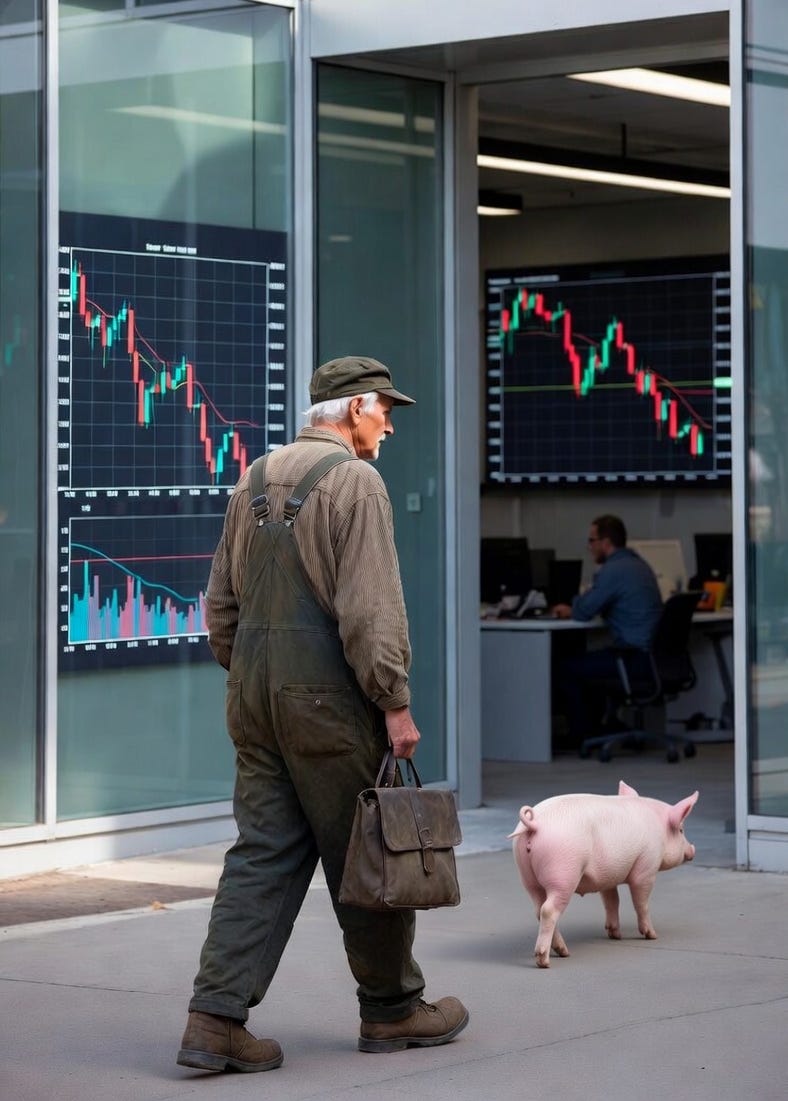
A Corny Investment Fable That Became Very Popular After Black Monday, 10/19/1987): There was once a very wise pig farmer. When the supply of hogs exceeded demand, and the pork market tanked, he didn't panic; he loaded up and eventually made a very nice profit. Likewise, whenever the stock market turned ugly and experts predicted even worse, he'd flip through his Value Line Investment Survey (remember that?) and pick about twenty solid companies trading more than 25% below their recent highs, and buy a few shares of each. Same as buying hogs at the bottom of the market. Then he'd go back to farming.
A few years later, when the financial pages were giddy, the “experts” were predicting the next great bull market, and his neighbors were finally getting excited, he'd sell every share and wait for the next panic.
Consistency Over Brilliance
Investing rewards consistency more than brilliance.
A series of average decisions, made with discipline, tends to produce better results than a handful of exceptional insights applied inconsistently. That’s not particularly exciting. It doesn’t make for good stories.
But it is durable. And durability is what compounds over time.
The Role of Process
When you step back, outcomes are shaped less by individual ideas . . . and more by the process behind them.
A sound process doesn’t guarantee success on every decision, but it improves the odds across many decisions.
It reduces the impact of emotion.
It limits the cost of being wrong.
It creates repeatability.
And over time, that repeatability becomes an advantage.
Final Thought
Intelligence has its place. But it’s not the deciding factor.
The market doesn’t reward the best ideas in isolation. It rewards the ability to manage uncertainty, apply discipline, and make consistent decisions over time.
That’s a different skill set. And it’s one that tends to matter more.
If you’re relying on insight alone, you may be missing the part that actually drives results: a well-structured process.
Great article Ward! I loved this phrase a lot: "The market doesn’t reward the best ideas in isolation. It rewards the ability to manage uncertainty, apply discipline, and make consistent decisions over time."
I hope to be like that!