

After 40 years in the investment business, let me tell you something I heard at least once a week - usually from smart, thoughtful people – regardless of what the market was doing or geopolitical worries.
“I’m not trying to time the market… I’m just waiting for a better entry point.”
I get it. It sounds disciplined, even responsible. But in plain English, it’s still market timing; just in retail investor jargon.
Very rarely will anyone admit to trying to time the market. The aggressive version—jumping in and out, chasing headlines, making big bets—that’s easy to spot. Most serious investors avoid that.
Instead, what they do is wait. They wait for things to “settle down.” They wait for a pullback. They wait until the headlines feel less uncomfortable.
But here’s the truth:
The headlines never feel less uncomfortable, every pullback seems like the beginning of a bear market, and things never “settle down”.
Once more for those in the back, “THINGS NEVER SETTLE DOWN”.
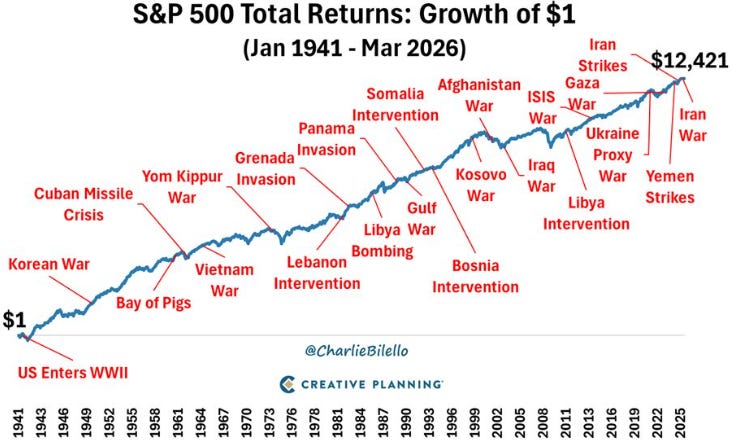
And while they’re waiting, they tell themselves they’re being patient, careful, and strategic.
What they’re really doing is making a quiet bet that they’ll recognize a better moment than the one in front of them right now.
Waiting feels smart.
If you invest and the market drops next week, you feel like you made a mistake. If you hold off and the market drops, you feel like you dodged a bullet.
Your brain tells you that inaction is safer than action. But investing isn’t about avoiding short-term regret. If it were, the only strategy would be to never invest at all.
What you’re really doing is trying to avoid the emotional discomfort of being early.
I once worked with a gentleman who, every time someone recommended we buy a stock, would say “I’d like to buy it - but 10% cheaper”. And if the stock went down 10%, he would still like to buy it 10% cheaper. If you never make a decision, you’ll never make a wrong decision.
The problem is that the market doesn’t reward comfort.
Often, the best returns occur when things feel the worst. I’ve lived through enough cycles to tell you this isn’t theory. The strongest rallies tend to start when the news is still negative, when uncertainty is still high, and when most people are still sitting on the sidelines waiting for clarity.
By the time things feel better, prices are higher. Clarity has a cost.
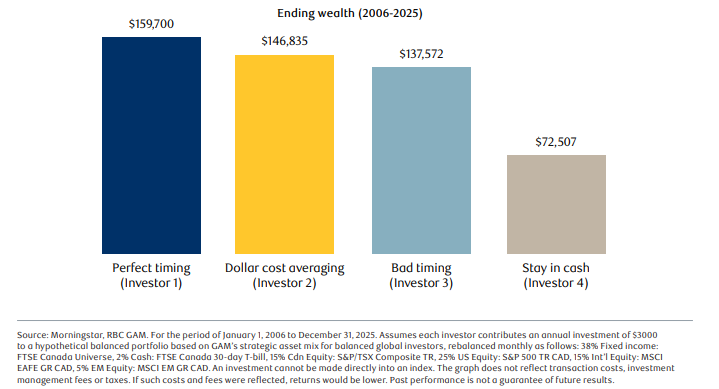
If you are reading this and have never heard the phrase “time in the market is more important timing the market”, you should find a better financial planner or investment advisor. I’m just trying to drive home the point that market timing does not improve your returns, and probably worsens them. Here’s an example:

There’s also something else going on, and it is human nature. When you say, “I’m waiting for a better entry point,” what you often mean is, “I’m not comfortable right now.”
That’s not a criticism—it’s reality. Markets are uncomfortable. They always have been.
But the idea that you’ll feel more comfortable at exactly the right moment to invest? That’s the part that doesn’t hold up. Because the market rarely gives you a clear signal. It just moves. And it usually moves ahead of your confidence, not in sync with it.
1. The investors who succeed aren’t the ones who figure out when to get in and out. They’re the ones who stop asking that question altogether. Here’s what they do instead:
2. They build a process. Simple or complex, it doesn’t matter. Just do it consistently so when you review your investments (and you should) you may see where the process broke down.
3. They decide how much they want in the market. Not your mortgage payment, not your living expenses, but only as much as you’re putting away for the long term. You can find hundreds, even thousands, of financial planners who will do a fine job of helping you quantify your allocation to stocks. But remember, any money you invest in stocks should be money you won’t need to spend in the next 5 years, at a minimum.
4. They decide how and when they’ll add to it. Will you make monthly deposits? Will you deposit your annual bonus – your tax refund?
5. And then they follow through—especially when it feels uncomfortable, and the market is down. Not because they’re fearless, but because they’ve accepted something most people resist:
Uncertainty isn’t a bug in the market; it’s a feature of investing.
If you take one thing from this, let it be this:
You don’t need to be good at timing the market to do well.
But the moment you start believing you can improve your results by “waiting for the right time,” you’ve introduced a problem that’s very hard to see in real time—and very expensive over the long run.
When you catch yourself saying, “I’ll wait for a better entry point,” just pause for a second. Maybe you’re right, but maybe - and this is usually the case -you’re just doing what investors have always done:
Trying to feel certain in a world that doesn’t offer it.
The market doesn’t pay for certainty; it pays for participation.