

Bad investments don’t begin as mistakes.
They begin as good ideas.
They use credible data.
They’re logical.
They come with compelling narratives.
More often than not, they’re backed by intelligent people.
That’s what makes them dangerous.
Because the failure rarely comes from the idea itself. It comes from what wasn’t examined closely enough.
The Seduction of a “Good Idea”
After four decades in the markets, I’ve seen this pattern repeat itself in every cycle.
A new opportunity emerges—sometimes a stock, sometimes a sector, sometimes an entire asset class.
The case is persuasive:
The growth story is clear
The macro tailwinds are supportive
The valuation appears reasonable—at least relative to expectations
And importantly, others are making money in it
At that point, the decision often feels less like risk-taking and more like common sense.
That’s the moment investors stop asking the most important question:
“What could go wrong?”
Because the goal isn’t to just be right most of the time. The goal is to survive being wrong.
Intelligence Isn’t the Problem
Investors don’t lose money because they’re unintelligent. They lose money because they’re incomplete.
The analysis is often thorough on the upside:
Revenue projections
Market expansion
Competitive positioning
Management quality
But the downside case—the part that actually determines survival—is often treated as a formality.
A paragraph.
A disclaimer.
An afterthought.
And that’s where the problem begins.
Most investment mistakes aren’t analytical failures. They’re unchallenged assumptions.
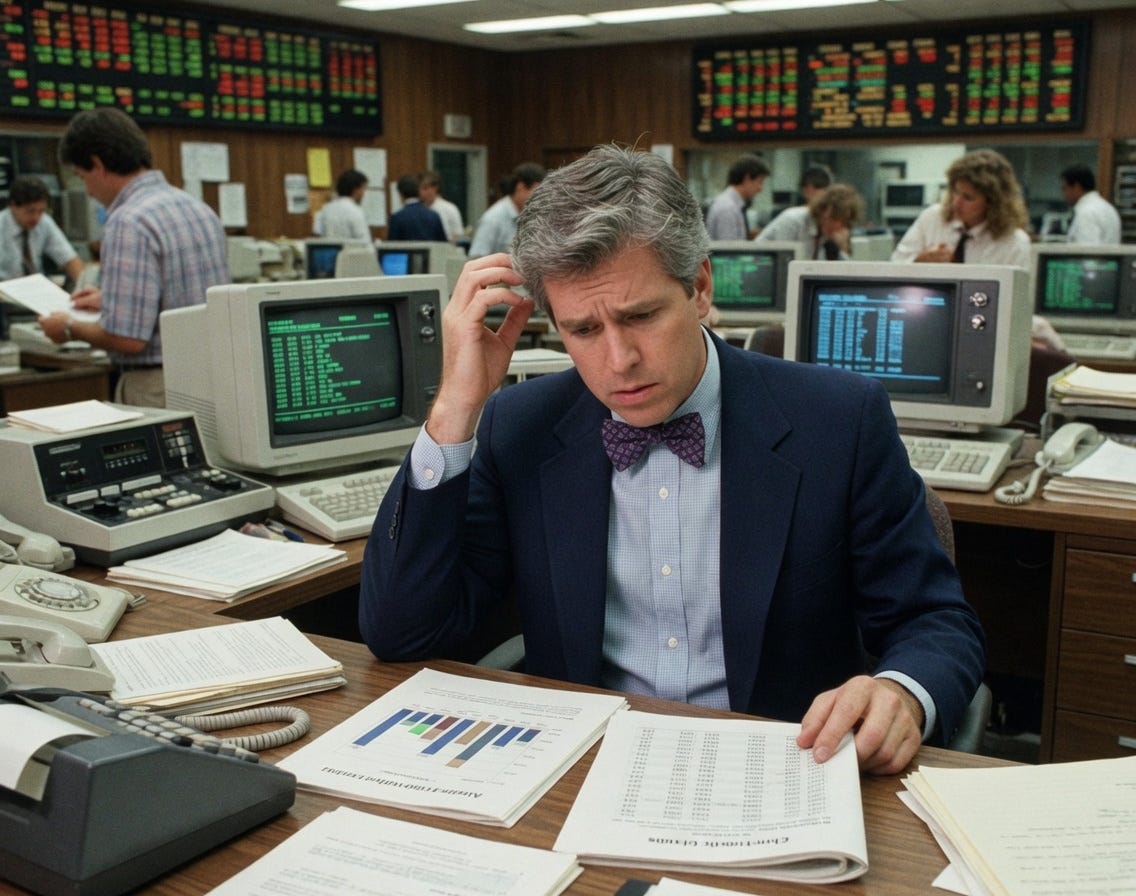
MARKET SCAR TISSUE (1989) The people on the wrong side of a trade are just as intelligent as the people on the right side. Their research is sound, their logic is robust, and their arguments are just as compelling. No one is right, or wrong, 100% of the time.
Where Good Ideas Break
Good ideas tend to break under pressure.
Not in theory - but in reality.
Because real-world outcomes introduce variables that don’t show up in a clean investment memo:
Liquidity disappears
Correlations go to one
Leverage magnifies small errors
Time horizons compress
Behavior overrides logic
And most importantly:
The market stops agreeing with you.
That last one is what hurts the most.
Because a good idea that doesn’t work is far more difficult to exit than a bad idea you never believed in to begin with.
The Missing Discipline: Downside First
Over time, I’ve come to believe that successful investing is less about identifying opportunity - and more about controlling damage.
That requires a shift in process:
Instead of asking, “How much can I make?”
Start with, “How much can I lose - and under what conditions?”
That’s not pessimism. It’s discipline.
It forces you to examine:
What has to go right for this to work
What happens if those assumptions are wrong
How quickly things can deteriorate
Whether you have the patience - and the capital - to withstand that
Most portfolios aren’t destroyed by a single catastrophic event.
They’re eroded by a series of “good ideas” that weren’t properly stress-tested.
Time Changes Everything
Another factor that turns good ideas into bad investments is time.
An idea can be correct—and still lose money.
If the timing is off…
If capital is tied up too long…
If opportunity cost becomes too high…
…the result is the same.
Investors often underestimate how sensitive outcomes are to timing and duration.
A thesis that works over five years can fail over twelve months.
And most investors don’t have the luxury—or the temperament—to wait that long. However, if you do have the luxury and the temperament, time is the great equalizer.
As Benjamin Graham said, “In the short run, the market is a voting machine but in the long run, it is a weighing machine.”
Position Size Is a Decision
Even when the idea is sound, implementation matters.
Position sizing is often overlooked, but it’s one of the most important risk controls available.
A good idea, sized poorly, becomes a bad outcome.
Too large—and it introduces unnecessary risk.
Too small—and it doesn’t matter.
The goal isn’t conviction. It’s balance.
Because conviction has a way of increasing right before reality intervenes.
The Role of a Second Set of Eyes
One of the most effective ways to avoid turning good ideas into bad outcomes is simple:
Get another perspective.
Not someone who will validate your thinking—but someone who will challenge it. A second set of eyes can:
Identify blind spots
Question assumptions
Highlight risks you’ve normalized
And most importantly, slow the decision down
In investing, speed is rarely an advantage.
Clarity is.
Final Thought
The market doesn’t reward good ideas, it rewards disciplined execution.
And discipline begins with understanding that every investment—no matter how compelling—contains risk that isn’t immediately obvious.
The goal isn’t to avoid good ideas. It’s to make sure they stay good after you commit capital.
Sometimes, a second set of eyes is the best investment you can make.