

Most investors think they are making decisions based on insight.
In reality, most are reacting to noise.
The difference between those two states, reaction and judgment, is the difference between the outcomes that compound and those that unravel, like the cut range ball you hit with your Big Bertha. And the gap between them is best understood through a simple framework: the progression from data to information, to knowledge, and ultimately to wisdom.
If you can discipline your investment process to move deliberately up that pyramid, you put yourself in a very small minority of market participants.
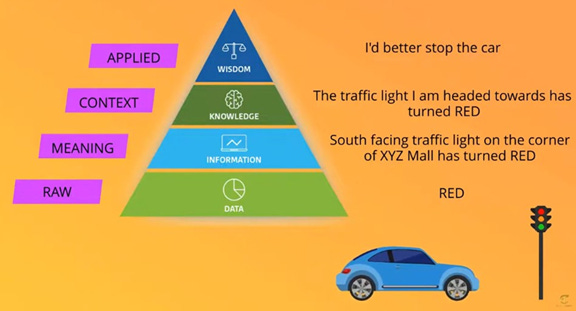
Source: CT Academy
Data: The Raw Inputs
At the base of the pyramid sits data, unprocessed, context-free, and often overwhelming.
In markets, data is everywhere. Price ticks, earnings releases, CPI prints, Fed statements, analyst upgrades, geopolitical headlines. It arrives constantly, in real time, and with no built-in hierarchy. And in the age of AI, you now have to figure out what is credible and what isn’t. Good luck.
The problem is not that data is wrong. The problem is that data by itself is meaningless. Most investors never leave this level. They consume, react, and transact. They confuse activity with insight.
Information: Adding Context
Information is what happens when data is organized and given context. Now events are compared, framed, and understood within a broader backdrop. Patterns begin to emerge.
But information still does not tell you what to do. It tells you what is happening—not what matters.
Knowledge: Recognizing Patterns
Knowledge is built over time. It is experience, pattern recognition, and understanding how markets behave. You begin to see cycles, sentiment shifts, and structural forces.
But knowledge alone is not enough—because markets test behavior, not intelligence. Discipline is much more important than IQ.
Wisdom: Applied Judgment
Wisdom is the ability to take everything below it and apply disciplined judgment. It is restraint when others react. It is patience when others rush.
It is clarity—earned through experience, not generated by algorithms.
Practical Application
A disciplined investor moves deliberately up this pyramid:
What does this mean?
Does it matter?
Have I seen this before?
Does it change my strategy?
Often, the best action is no action at all.
Final Thought
The goal is not to eliminate uncertainty, but to operate with clarity within it.
Most investors live at the bottom of the pyramid. The ones who succeed operate at the top.
And that’s not just an investing lesson, that’s a life lesson.
~~ Ward